Forget being in the audience—spatial audio makes you feel like you’re on stage. Whether it’s rain lashing around you in a Doctor Who episode or a choir soaring overhead at the BBC Proms, this 3D sound tech is revolutionising UK listening. But what exactly is it? Let’s demystify the buzzword with science, wit, and a proper cuppa.
Spatial audio (or “immersive audio”) creates a 360-degree sound sphere around you. Unlike stereo (left/right) or surround sound (front/back/sides), it adds height and depth. Think of a helicopter circling overhead in a film—sound moves above, behind, and beside you. It mimics real-life hearing by placing “sound objects” in 3D space, from whispering ghosts to thunderclaps 713.
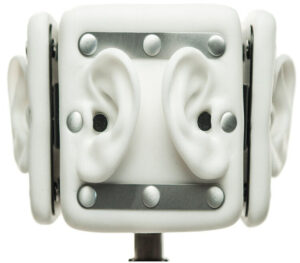
3Dio Omni Pro binaural microphone, credit 3Diosound
Our ears detect sound location using interaural time differences (which ear hears first) and head-related transfer functions (how your skull/ears shape sound). Spatial audio exploits these cues via complex algorithms. The result? A violinist might sound 2 metres ahead and slightly left—like they’re actually in your living room 1112.
Traditional audio uses fixed channels (e.g., “left speaker”). Spatial audio treats sounds as movable “objects” tagged with metadata (e.g., “dragon roar: 30° left, 10m away”). Your device then renders these in real-time, adapting to your setup—be it headphones, soundbar, or speakers 613.
Headphones (Binaural): Uses HRTFs to simulate 3D space. Pro tip: Works best with head tracking (e.g., AirPods Pro)—turn your head, and the sound stays “fixed” in the room, like a real noise would 911.
Speakers: Systems like Dolby Atmos use upward-firing drivers (e.g., Sonos Arc) to bounce sound off ceilings. No need for 12 ceiling speakers—just clever physics 1314.
Surround sound (e.g., 5.1) uses set speaker positions. Spatial audio is agnostic: it maps sounds dynamically. Lose a speaker? It recalibrates. Swap headphones for a soundbar? No remixing needed. This makes it ideal for UK living rooms—where space (and partner approval) for kit is limited 614.
Dolby Atmos (a spatial audio format) adds verticality. In The Witcher on Netflix, rain doesn’t just surround you—it falls from above. Traditional 7.1 surround can’t do this without physical ceiling speakers 714.
Dolby Atmos: Dominant in UK cinemas/streaming (Disney+, Netflix). Requires licensing fees.
Open Formats: Eclipsa Audio (Google/Samsung’s royalty-free format) and Ambisonics (favoured by BBC R&D) democratise creation. Eclipsa even offers a free Pro Tools plugin 39.
Apple Music’s Spatial Audio (no extra cost) lets Zane Lowe “sit inside” a Kanye West track. Sony 360 Reality Audio places instruments in a circle—ideal for Glastonbury livestreams 1014.
| Device | Budget | UK Picks |
|---|---|---|
| Headphones | £150+ | Apple AirPods Pro, Sony WH-1000XM5 |
| Soundbars | £400+ | Sonos Arc, Bose Smart Ultra |
| Speakers | £750+ | Microcosm Audio XXX |
Expert note: For true height effects, ensure “upward-firing drivers” (Sonos Era 300 nails this) 1314.
BBC iPlayer: Look for “Atmos” tags (e.g., Doctor Who, Proms).
Netflix/Disney+: Requires Premium subs. Search “spatial audio” 714.
Apple Music: 100M+ tracks—try The Beatles’ Abbey Road remix.
Skip the £6,500 binaural head! BBC recommends in-ear mics (£85) or tetrahedral Ambisonics mics (Zoom H3-VR). For DIYers: a wig stand + lapel mics = “good enough” tests 9.
Avoid mixing binaural and mono mics—it breaks immersion.
Do use free tools: IEM Plugin Suite or 3D Tune-In Toolkit for game audio 812.
Spatial audio isn’t just louder—it’s more human. It transforms Ed Sheeran gigs into front-row experiences and Peaky Blinders shootouts into heart-in-mouth moments. As the BBC’s Chris Pike notes, it’s about “future-proofing” sound for the next 50 years—no extra speakers required 910.
So, put the kettle on, queue up Atmos-enabled Blue Planet, and let your ears climb out of the flatlands. Stereo’s had a good run—but the future’s spherical.
Got questions? Tweet us @UKAudioGuide—we answer every query (between tea breaks).
Further Reading: BBC Academy’s Spatial Audio Guide | Dolby Atmos on Sonos
About the Author: Hugh is a sound tech journalist and reformed DJ whose AirPods have survived 3 Manchester downpours. He believes spatial audio pairs best with Yorkshire Gold.* ☕